Art As Light, Clothes As Memories.
Curated artworks

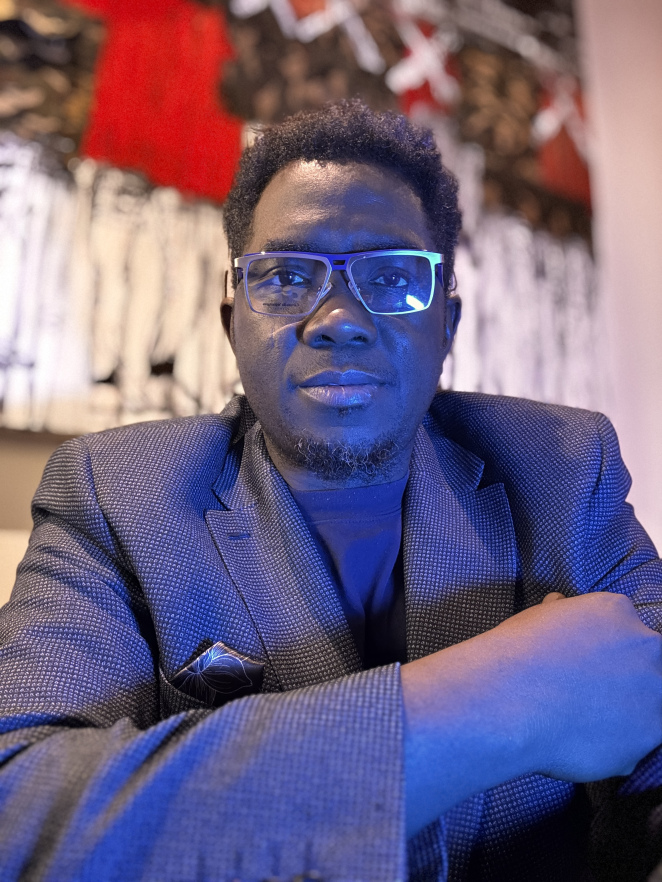
Suraj Adekola (b. 1983) is a contemporary artist exploring the intersection of value, culture, identity, and materiality through controlled visual experimentation.
With works featured in galleries across the globe, Suraj continues to push boundaries and challenge perceptions through his unique visual language.
ARTIST STATEMENT
My work feels closer to music and poetry than image. Music and poetry don’t explain themselves. They create conditions for feeling that bypass the analytical mind and arrive somewhere deeper. What you feel when you stand in front of a Miles Davis recording or a Lao Tzu verse — something happens before you understand why. The meaning and the experience are simultaneous. My work sits in that harder space between abstraction, identity, memory, labour, value, inheritance, and spiritual residue — without needing to announce itself loudly.
My work begins in Abeokuta, Ogun State, where adire cloth has long functioned for generations as economic currency, spiritual object, and living memory. Made by Egba women, traded through networks that sustained households. I grew up around it before fully understanding its meaning. My mother wore it. I followed my father through Abeokuta as a child, absorbing its presence without yet knowing how deeply it would shape me.
I was born in Lagos. I live and work in Manchester — a city built on the same colonial textile trade that extracted value from the traditions I carry. In my studio I use adire sourced directly from Abeokuta together with fabrics coffee-dyed and artificially aged by hand. The coffee is not a neutral material. Its scent carries my mother — her morning ritual, now gone — and carries me, newly arrived in a cold country, warming myself against unfamiliar weather. Two memories held in one material.
I romanticise the idea of vintage. I work with fragments of adire alongside artificially aged and distressed textiles, assembling layered surfaces that move between memory, labour, migration, and value. The staining and aging are not decorative gestures. They are attempts to travel backwards through material — to sense the time embedded in cloth, the bodies that carried it, and the histories that remain inside it. Through layering, repetition, erosion, and repair, the textiles begin to behave less as surfaces and more as carriers of time. I am not referencing history. I am continuing it.
The work lives in the liminal space between textile and painting — where the viewer needs to find their own way in. Across wall-based compositions and immersive hanging installations, viewers are invited to move around and in front of layered textile environments where personal memory and collective history fold into one another. Rather than offering fixed narratives, the work opens spaces for reflection — on what transforms anything into treasure, and the shifting ways value is assigned to bodies, traditions, and cultural forms, particularly within the relationship between Africa and the global systems of value.

In We Should All Be Blacks, I explore the intricate relationship between Blackness and Britain, drawing from postcolonial theories and historical material. Central to my work is an examination of colonialism's lingering effects on cultural identity within Black Atlantic communities. Through visual culture and historical narrative, I illuminate the enduring legacies of oppression and resilience.
This series serves as a visual dialogue between past and present, blending contemporary expression with historical references to evoke connection and dislocation. Using Adire fabric, I weave narratives of fragility, diversity, and unity, symbolizing the resilience of Black identity. Employing Cubist-inspired techniques, I manipulate the fabric to reflect cultural hybridity and Pan-Africanism.
As a Nigerian artist in the UK, my work reflects a love for my Yoruba culture while resonating with universal experiences of cultural adaptation. I challenge conventional notions of identity and representation, inviting viewers to reconsider their relationship to history, migration, and the ongoing struggle for cultural preservation.

Same Face, Different Backgrounds, is a remarkable endeavour that resonates with the values of the organisations that work to prevent wars and promote peace worldwide. This piece is 195 pieces, each representing a different country. This project showcases the power of art to promote peace and unity on a global scale.
The project's profound message emphasises that, despite our diverse backgrounds and beliefs, we all share the same human face. It serves as a poignant commentary on the ongoing conflicts in the world, such as the war between Hamas and Israel, encouraging a vision of harmony and understanding. This project undoubtedly aligns with the missions of international organisations such as the United Nations (UN), the International Court of Justice (ICJ), the North Atlantic Treaty Organisation (NATO), the African Union (AU) and the Organisation for Security and Cooperation in Europe (OSCE). There are a few key international bodies that work to prevent wars and promote peace worldwide. It is to foster meaningful dialogue and promote a more peaceful world through artistic expression.

In this series, Water No Get Enemy, Ye, I examine the interplay of personal experience and memories, historical contexts, and the process of learning about myself and how I coexist with the world.
I draw inspiration from Nigerian musical influences such as Fela Anikulapo Kuti’s Afrobeat anthem “𝗪𝗮𝘁𝗲𝗿 𝗡𝗼 𝗚𝗲𝘁 𝗘𝗻𝗲𝗺𝘆,” which emphasises resilience and unity with the line “Water e no get enemy,” and Burna Boy’s introspective track “Ye,” with the line "𝗬𝗲, 𝗬𝗲, 𝗬𝗲, 𝗬𝗲, 𝗬𝗲, 𝗬𝗲, 𝗬𝗲,”.
Through a fusion of artistic expression and cultural symbolism, I sought to capture the essence of the journey towards self-discovery and one’s place within the broader societal landscape.
While I was making this series, I was thinking a lot about the significance of materiality, particularly the traditional Adire (tie-dye) fabric, as a conduit for cultural memory. Incorporating Adire into the paintings symbolises a tether to heritage and tradition, anchoring the artwork in the rich tapestry of Nigerian culture.
The use of lines to draw faces within the compositions reflects the fluidity of migration, echoing the movement and transitions experienced both personally and within broader societal contexts.
This series, ‘Water No Get Enemy, Ye,’’ invites viewers to contemplate the complexities of migration, identity, memory, and the ever-evolving relationship between self and society.